
Article: Wabi-Sabi in Menswear: The History of Patchwork and the Beauty of Imperfection
Wabi-Sabi in Menswear: The History of Patchwork and the Beauty of Imperfection

For decades, classic menswear has been obsessed with pristine perfection. The spotless white shirt, the razor-sharp crease of a trouser, the immaculate polish of a dress shoe. But there is an entirely different approach to style—one that finds elegance not in flawlessness, but in character, history, and the passage of time.
The Japanese call this philosophy Wabi-Sabi: the acceptance and appreciation of beauty that is imperfect, impermanent, and incomplete. In the world of textiles and menswear, this philosophy finds its truest expression in the art of patchwork.
Here is how a centuries-old survival technique evolved into one of the most sophisticated visual statements in modern menswear, and how to incorporate the wabi-sabi aesthetic into a contemporary wardrobe.

The Origins of Architectural Clothing: Boro and Sashiko
To understand the depth of patchwork, you have to look at its origins. In 17th-century rural Japan, cotton was a luxury reserved for the elite. The working class wore garments woven from hemp. Because fabric was scarce and winters were brutally cold, a single garment was meant to last a lifetime—and often, several lifetimes.
When a garment tore or wore thin, it wasn't discarded. It was patched with whatever scrap fabrics were available, stitched together using a running stitch known as Sashiko. Over decades of mending, a single jacket might contain dozens of different indigo-dyed fabrics, overlapping and fading at different rates. These garments, known as Boro (meaning "tattered" or "repaired"), were born out of absolute necessity.
Yet, over time, a profound aesthetic emerged. The geometric collision of different fabrics, the textured ridges of heavy stitching, and the gradient of fading indigo created garments with an architectural depth that no single piece of pristine fabric could ever replicate. It was wabi-sabi realized in cloth: the scars and repairs didn't detract from the garment's value; they became its defining feature.
Modern Translation: Visual Depth Without the Weight

True vintage patchwork is heavy, stiff, and exceptionally warm—qualities that do not translate well to a modern, humid climate. The challenge for contemporary menswear is capturing the visual poetry of wabi-sabi and patchwork without the restrictive weight of layered, hand-stitched textiles.
The solution lies in modern fabric engineering and high-fidelity printing. By translating the complex geometry of patchwork onto lightweight, modern fabrics, you get the visual depth of the aesthetic with the comfort demanded by everyday wear.
Our Geometric Print Silky Finish Relaxed Fit Shirt captures this perfectly. It utilizes a silky-soft cotton sateen that is digitally printed for vivid, long-lasting colour. Because the complex geometric patchwork pattern is applied via digital print technology rather than physical fabric layering, the shirt remains incredibly breathable. Cut in a relaxed fit and finished with a German-interlined stretchable collar and pearlised buttons, it delivers the character of traditional patchwork with effortless, modern comfort.
Tailored Imperfection: The Patchwork Blazer

Traditionally, tailoring and patchwork sit at opposite ends of the menswear spectrum. Tailoring is about precision and exact rules; patchwork is about organic growth and asymmetry. Combining the two creates a striking tension that works beautifully for smart-casual environments.
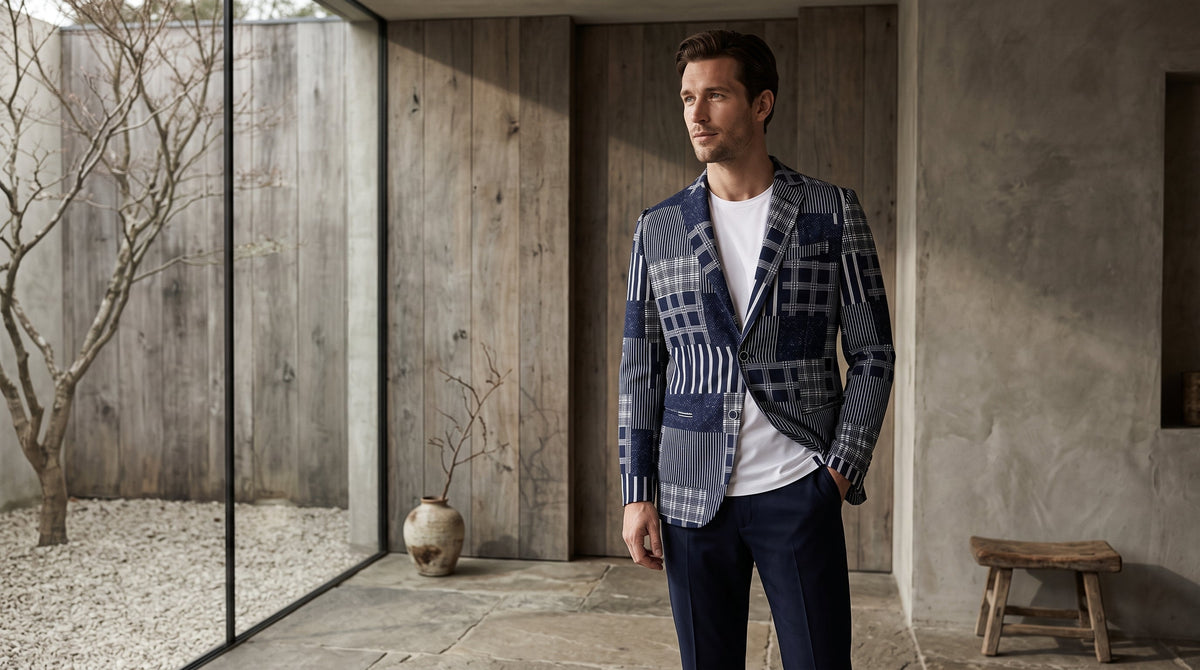
The Blue & White Patchwork Single Breasted Blazer applies this rugged aesthetic to a tailored slim silhouette. It is engineered to be machine-washable, stretchable, cooling, and wrinkle-resistant. It features functional inner and outer pockets alongside underarm sweat guards for all-day ease, making it a highly practical piece for travel or long days in the city.
For a more subdued take on the aesthetic, the Denim Blue Pattern Single Breasted Blazer offers a similar slim, single-breasted half-lined construction. Like its bolder counterpart, it is machine-washable and features underarm sweat guards. Both blazers prove that you can wear a statement pattern without sacrificing the ease of modern performance features.
How to Wear the Wabi-Sabi Aesthetic

When incorporating patchwork and complex geometric prints into your rotation, the styling rule is simple: let the pattern do the heavy lifting.
- Anchor with Solids: Because a patchwork piece carries multiple shades and visual textures, pair it with solid, neutral bottoms. Black, khaki, or olive chinos allow the print to remain the focal point without clashing.
- Dress Down the Tailoring: A patchwork blazer should never be worn with a tie. Pair it over a crisp white organic cotton tee or a lightweight linen shirt worn open at the collar.
- Embrace the Relaxed Silhouette: The wabi-sabi philosophy is inherently relaxed. Avoid overly tight styling. The drape of a silky-finish relaxed shirt worn untucked over casual trousers perfectly mirrors the effortless nature of the aesthetic.
Perfection in menswear is impressive, but character is what actually makes an outfit memorable. Embracing prints inspired by the history of patchwork is the easiest way to introduce that character into a modern wardrobe.

Shop the Patchwork Collection
- Geometric Print Silky Finish Relaxed Fit Shirt — 100% cotton sateen, digitally printed, available in navy blue and black.
- Blue & White Patchwork Single Breasted Blazer — Machine-washable and cooling fabric in a slim tailored fit.
- Denim Blue Pattern Single Breasted Blazer — Machine-washable with underarm sweat guards.

Written by The Shirt Bar Shopify

